
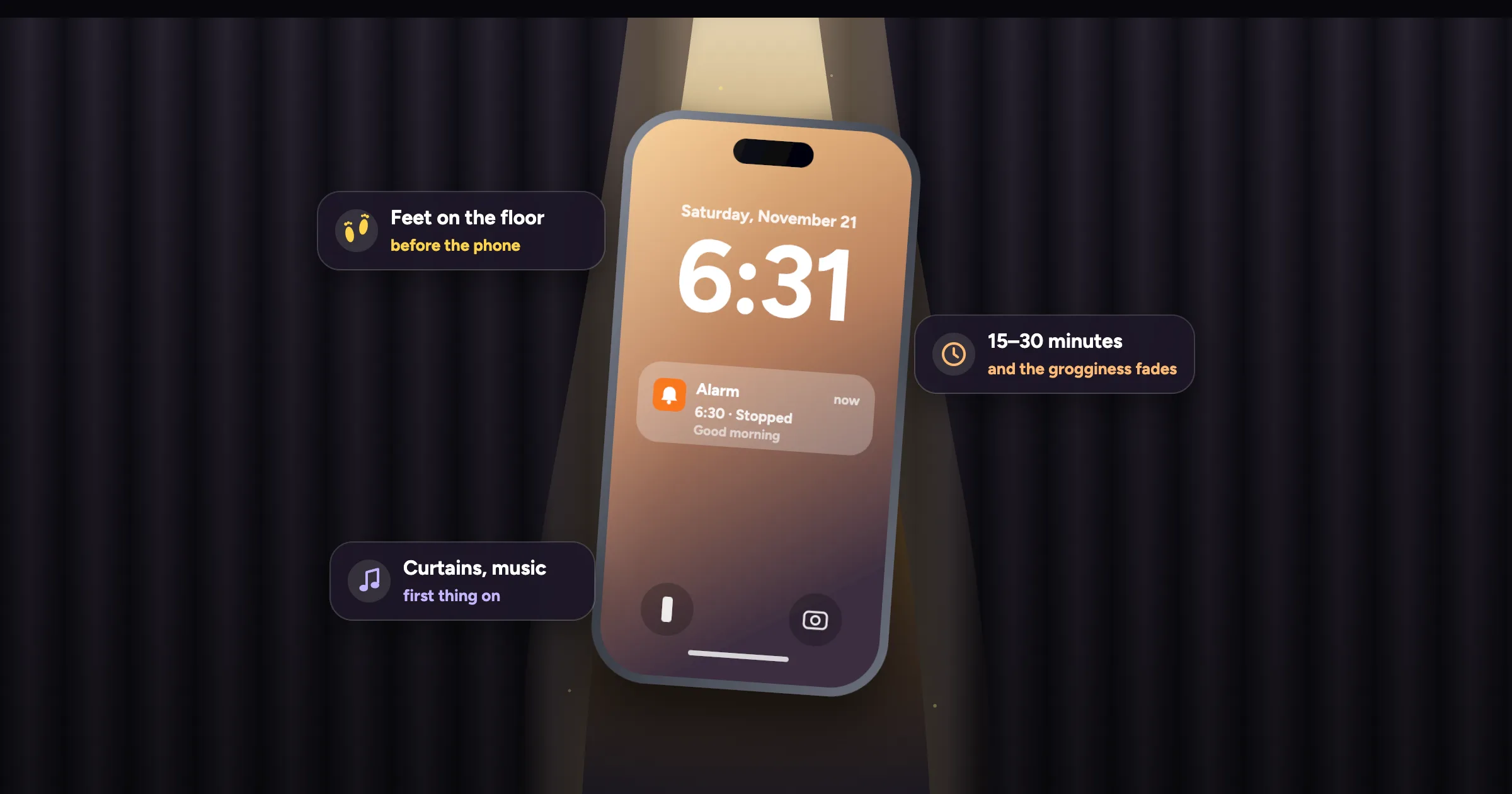
Getting out of bed is hardest in the first minutes after waking, when sleep inertia is at its worst. It mostly lifts within 15 to 30 minutes, so the trick is to be up before you start negotiating:
- decide the night before with an if-then plan: “when the alarm stops, feet on the floor”,
- put the alarm where you have to stand up to stop it, and get up before you check your phone,
- open the curtains or turn on every light, put on music you like, and leave the bedroom,
- if it’s every morning, look at how much you sleep and how late your weekends run.
If you can’t get up most days for more than two weeks and also feel low or have lost interest in things, that’s worth a talk with a doctor.
On this page
Why is it so hard to get out of bed in the morning?
Waking up isn’t a switch. For a while after you open your eyes, parts of your brain are still running in sleep mode: you’re slower, foggier and worse at decisions than you’ll be an hour later. Sleep researchers call it sleep inertia. A 2019 review of the research found that most of it fades within 15 to 30 minutes, although full recovery can take an hour or more. That’s the exact window in which you’re lying there deciding whether to get up, with the least capable version of your brain doing the deciding.
Sleep inertia hits harder when you’re short on sleep and when the alarm goes off during your body clock’s night. So if getting up is a fight every single day, something on this list is usually making it worse:
| What’s going on | How it feels | What helps |
|---|---|---|
| Sleep inertia | Heavy and foggy for the first 15–30 minutes, fine later | Get up anyway, then light and music |
| Too little sleep | Hard every weekday, easier after a long weekend | Move bedtime earlier, aim for 7+ hours |
| Your body clock runs late | Wide awake at midnight, useless at 7 | Morning light and a gradual plan |
| Weekend lie-ins | Monday is the worst morning of the week | Keep weekend wake time within about an hour |
| Snoozing | Three snoozes and you’re more tired, not less | Snooze off, alarm across the room |
| Low mood that lasts | Every part of the day feels heavy, not just the morning | Talk to a doctor |
Not hearing the alarm at all, or turning it off without remembering, is a different problem; our guide on why you sleep through your alarm covers it. This one is about the moment after: you’re awake, and still not getting up.
What should you do in the first 10 minutes?
The aim isn’t to feel ready. You won’t, not for another quarter of an hour. The aim is to be vertical before your groggy brain has time to argue. Eight steps, in the order they happen:
- Decide tonight, not at 6:30. Make one if-then plan before bed: “When the alarm stops, I put my feet on the floor.” In a review of 94 studies, plans written in this if-then form helped people follow through on their goals noticeably more often than good intentions alone. It works because the decision is already made when the moment comes.
- Put the alarm out of reach. If stopping it means walking across the room, you’re already out of bed by the time it’s quiet. That’s half the job done before you’ve had a chance to object.
- Feet on the floor before the phone. Sit up, swing your legs out, stand. Checking messages lying down is how 6:52 becomes 7:20. The phone can wait until you’re in the kitchen.
- Let the light in. Open the curtains or switch on every light. In a 2022 sleep lab study, bright light right after waking left people more alert and in a better mood than dim light. That study woke people at night, and daytime studies found smaller effects, but light has a second payoff: light early in the day moves your body clock earlier, so tomorrow’s alarm lands closer to your body’s morning.
- Put on sound you like. The research is early and small, but sound is one of the few things that has eased grogginess after waking in lab studies, and a 2020 survey linked melodic alarm tones with feeling less groggy. A playlist you actually look forward to is a better companion than silence.
- Leave the bedroom. The bed is right there and lying back down for “one more minute” is easy. Go somewhere you can’t lie down: the kitchen, the bathroom, the balcony.
- Have something to get up for. A first coffee, a shower you like, five quiet minutes before the house wakes up. Make it small and make it yours. Coffee works better as the reward than as the fix: caffeine taken after waking acts too slowly to clear the worst of the first-minute fog.
- Give it 15 minutes before judging the day. How you feel at 6:31 says very little about how you’ll feel at 7:00. If you’re up and moving, the fog lifts on its own schedule.
What can you set up tonight?
Most of what decides tomorrow morning happens tonight. A few minutes before bed takes the fight out of 6:30:
- Count back from your wake-up time. Adults need at least 7 hours, and the bedtime calculator shows when to be in bed for it. Short nights make every other step harder.
- Charge the phone across the room. It doubles as the alarm you have to stand up for, and it keeps the late scroll out of bed.
- Turn snooze off. Each snooze restarts the struggle from the beginning. Our guide on what snoozing does has the research.
- Lay out the first five minutes. Clothes on the chair, the kettle filled, the curtains easy to open. Fewer decisions in the morning means fewer chances to stall.
- Keep weekends close. Sleeping until noon on Sunday shifts your body clock later, and Monday feels like jet lag. Sleep researchers call it social jetlag. Keep your weekend wake time within about an hour of your weekday one. If you’re a night owl trying to move earlier, this 3-week plan does it in 15-minute steps.
When is it more than a bad morning?
Everyone has mornings when getting up feels impossible, and a run of them after late nights or a stressful week is normal. Look closer if it doesn’t let up:
- Low mood that lasts. Health services advise seeing a doctor if symptoms of depression, such as low mood, having no motivation or interest in things and a lack of energy, last most of the day, nearly every day, for more than two weeks. If you ever feel in crisis, contact emergency services or a crisis line straight away.
- Exhausted despite enough sleep. If you spend 7 to 9 hours in bed and still wake up drained, or you snore loudly and someone has noticed you stop breathing in your sleep, ask a doctor about sleep apnea. Our guide on sleeping through alarms lists the other warning signs.
None of the steps above replace that conversation. They’re for ordinary hard mornings, which is most of them.
An alarm that needs you out of bed
Every step above has the same weak spot: you have to choose it at the moment you least want to. Wakin moves that choice to the night before. The alarm only stops once you’ve done a mission you can’t do lying down:
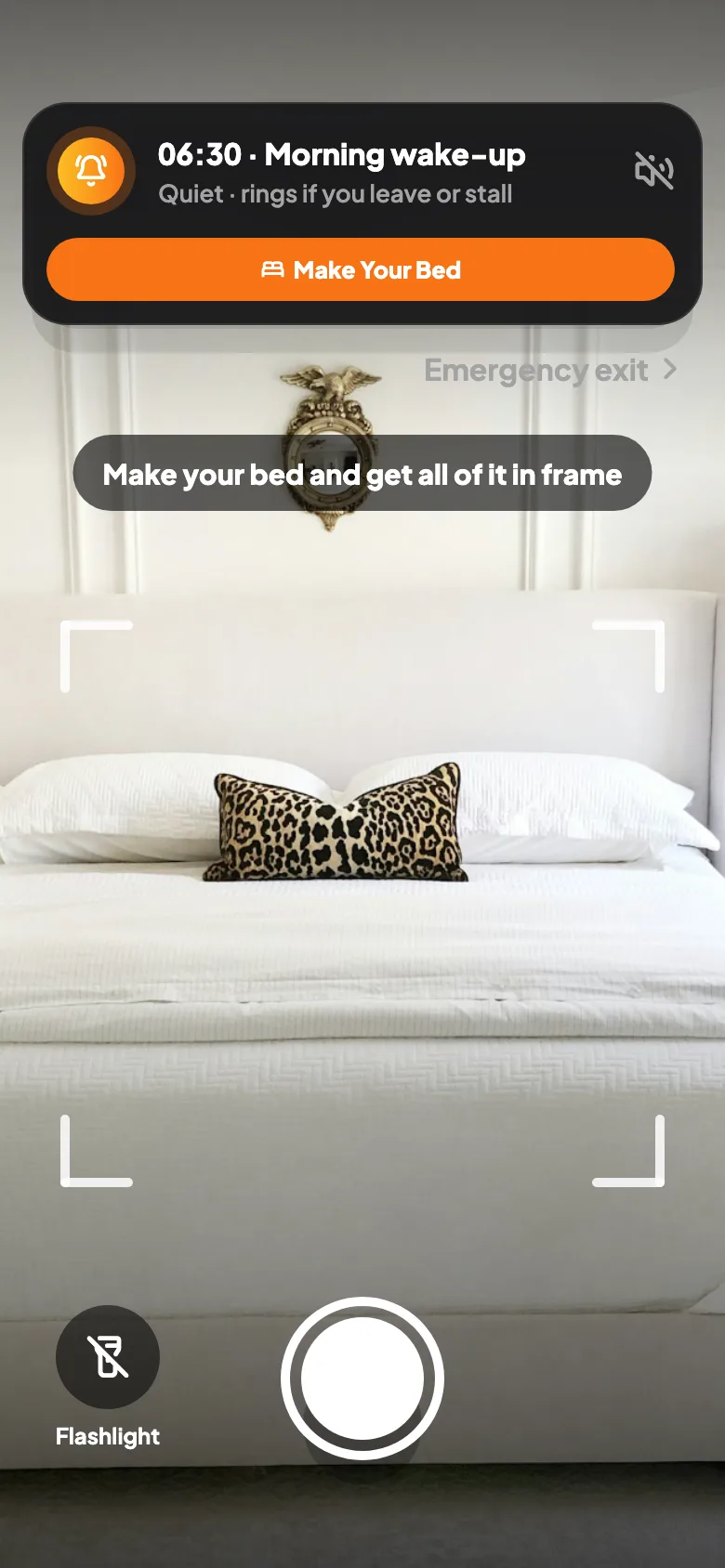
- Make Your Bed: take a photo of your made bed. Hard to crawl back into one you’ve just made.
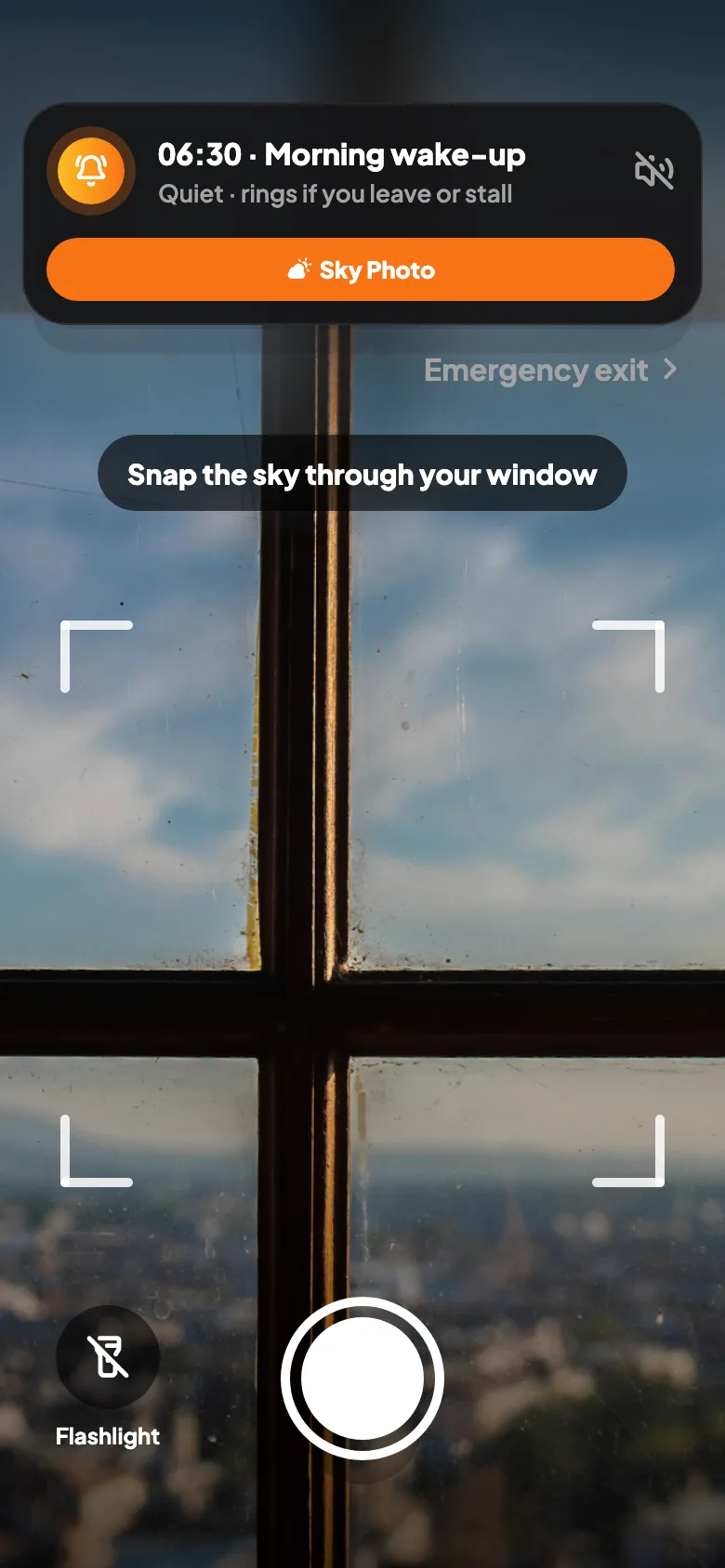
- Sky Photo: snap the sky through your window, so the curtains are open and the light is in.
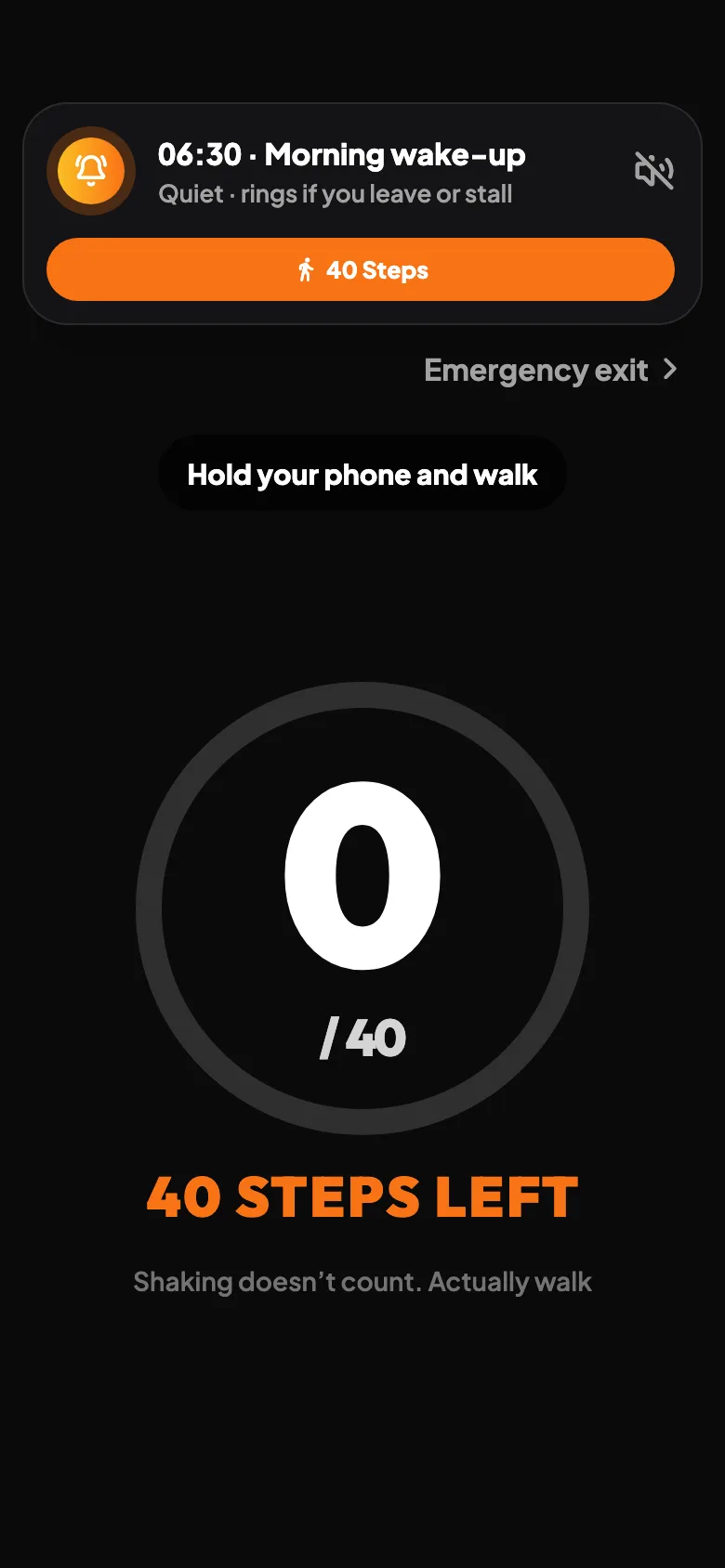
- Walk It Off: walk 40 steps with your phone in your hand. Shaking it doesn’t count.
The alarm goes quiet while you do the mission and rings again if you leave the app or stall for 60 seconds. Snooze is off by default. If you tend to go back to bed afterwards, the optional “You up?” check asks again 5, 10 or 15 minutes later; no tap within 100 seconds and the alarm rings again.
Frequently asked questions
Why can’t I get out of bed in the morning?
Usually it’s sleep inertia, the groggy state right after waking that mostly lifts within 15 to 30 minutes. It gets worse when you’re short on sleep, when the alarm rings during your body clock’s night (common for night owls and after weekend lie-ins) and when you snooze. If you can’t get up most days for more than two weeks and also feel low or have lost interest in things, talk to a doctor.
How do I force myself to get out of bed?
Don’t rely on willpower at 6:30. Decide the night before with an if-then plan (“when the alarm stops, my feet go on the floor”), put the alarm where you have to stand up to stop it, and get up before you pick up your phone. Then open the curtains or turn on every light. The first minute is the hardest part; it gets easier after that.
How long does morning grogginess last?
Most of it is gone within 15 to 30 minutes, according to a 2019 review of sleep inertia research, but full recovery can take an hour or more. That’s why the first minutes feel so much worse than the rest of the morning, and why it’s worth getting up before you judge how tired you are.
Is not being able to get out of bed a sign of depression?
It can be one sign, but on its own it usually isn’t. Health services advise seeing a doctor if symptoms of depression, such as low mood, no motivation or interest in things and a lack of energy, last most of the day, nearly every day, for more than two weeks. If you ever feel in crisis, contact emergency services or a crisis line straight away.
Does opening the curtains help you wake up?
It helps. In a 2022 lab study, bright light right after waking made people more alert and more cheerful than dim light, although daytime studies have found smaller effects. Light also has a longer payoff: light early in the day moves your body clock earlier, so waking up gets easier over time.
Should I drink coffee as soon as I wake up?
Coffee is a fine reason to get up, but it won’t get you up. Caffeine taken after waking acts too slowly to clear the worst of the first-minute grogginess. Use it as the reward: you have to stand up and walk to the kitchen to make it.
How do I stop going back to bed after my alarm?
Make the first thing after the alarm something you can’t do lying down: walk to the alarm across the room, open the curtains, leave the bedroom. A mission alarm that only stops once you’re up, plus a check a few minutes later that rings again if you don’t answer, closes the gap where most people crawl back under the covers.
Sources
- Hilditch & McHill (2019): Sleep inertia, current insights. Nature and Science of Sleeppmc.ncbi.nlm.nih.gov
- Gollwitzer & Sheeran (2006): Implementation intentions and goal achievement, a meta-analysis of effects and processes. Advances in Experimental Social Psychologydoi.org
- Hilditch et al. (2022): Rise and shine, the use of polychromatic short-wavelength-enriched light to mitigate sleep inertia at night following awakening from slow-wave sleep. Journal of Sleep Researchdoi.org
- Khalsa et al. (2003): A phase response curve to single bright light pulses in human subjects. The Journal of Physiologydoi.org
- McFarlane et al. (2020): Alarm tones, music and their elements. PLOS ONEjournals.plos.org
- Roenneberg et al. (2012): Social jetlag and obesity. Current Biologydoi.org
- About Sleep: how much sleep you need by age (CDC)cdc.gov
- Depression: symptoms and when to see your GP (nidirect, NHS Northern Ireland)nidirect.gov.uk
- Sleep apnea: symptoms (NHLBI, NIH)nhlbi.nih.gov
More guides
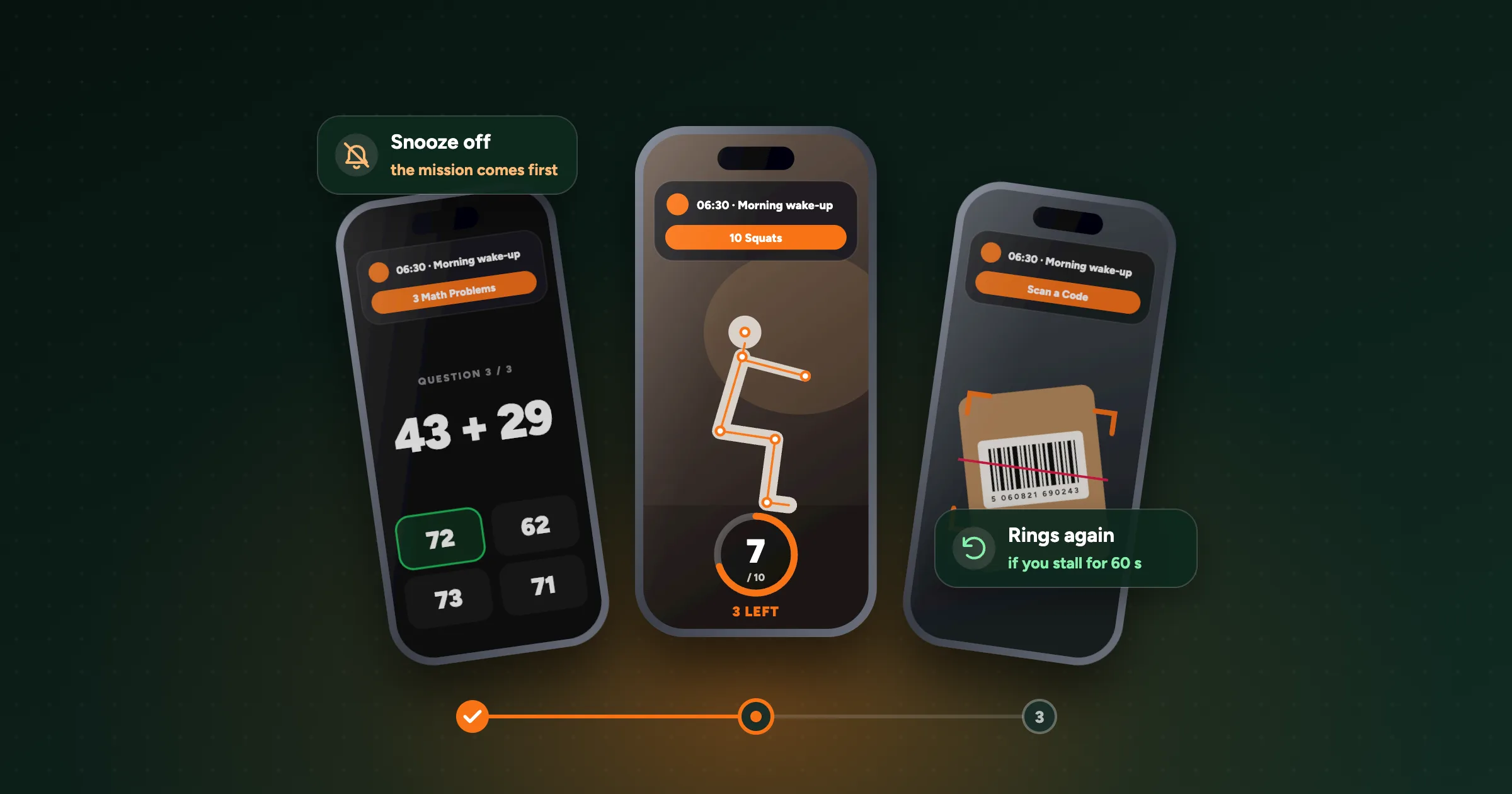
What Is a Mission Alarm? The Alarm That Won’t Stop Until You’re Up
A mission alarm won’t stop until you finish a task: math, a photo, a barcode or push-ups. Which missions really get you out of bed, and how hard to set them.
Read the guide →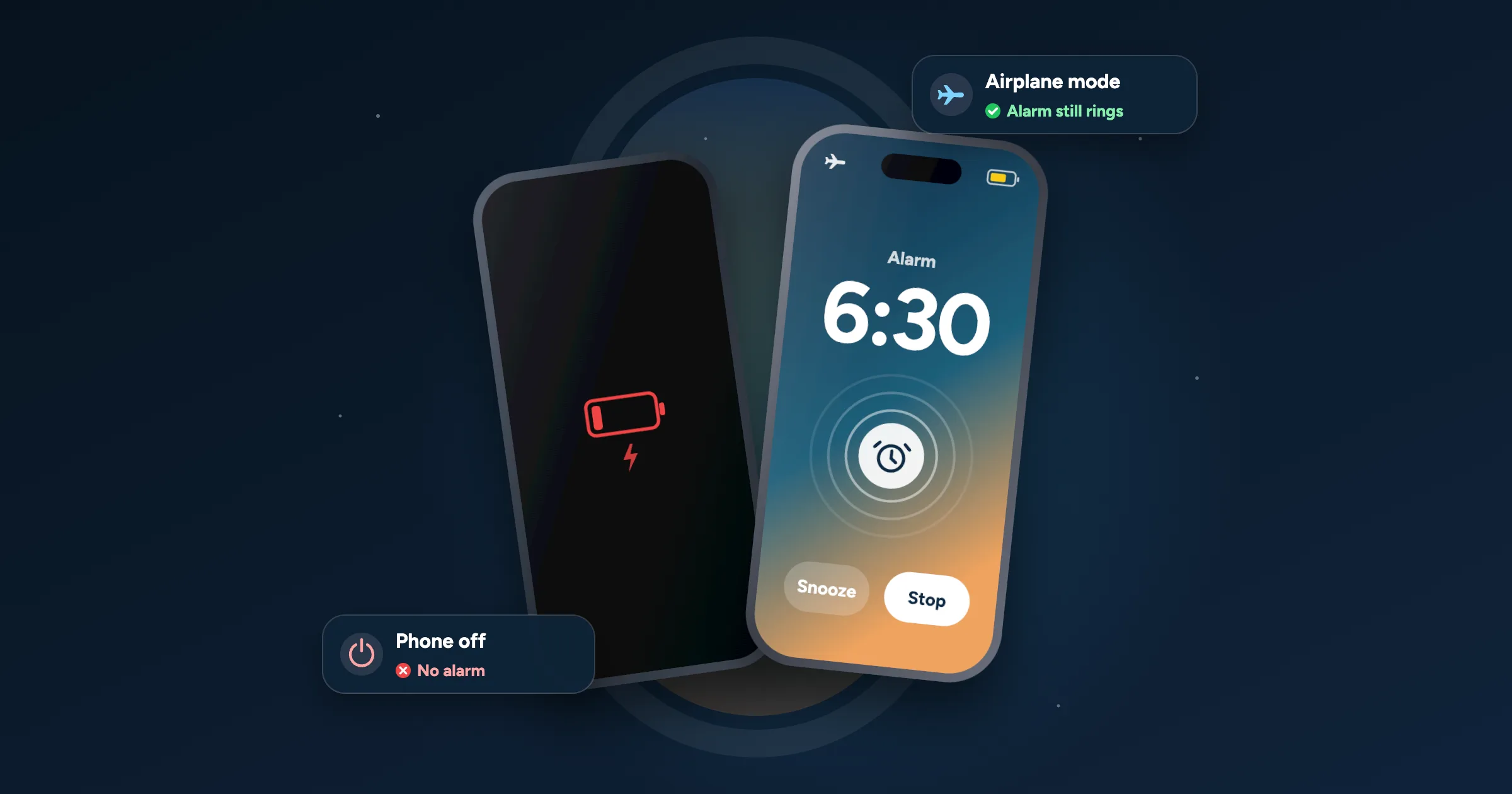
Will My Alarm Go Off If My Phone Is Off, Dead or in Airplane Mode?
Not if it’s off or dead (with two rare exceptions). Yes in airplane mode, Low Power Mode and offline. 10 situations on iPhone and Android, and 5 traps.
Read the guide →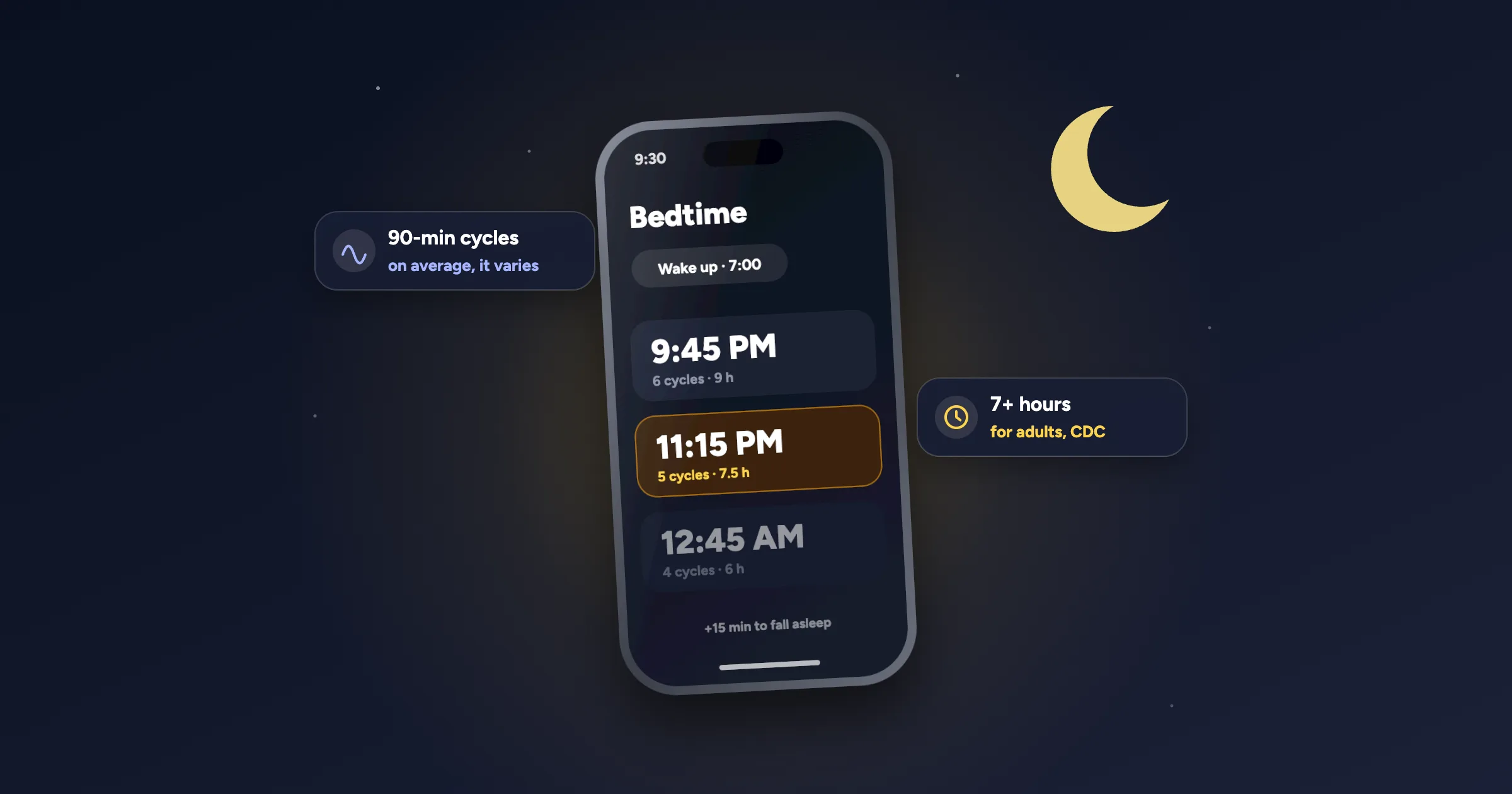
What Time Should I Go to Bed? Sleep Cycle Calculator
Enter your wake-up time and get bedtimes for 4, 5 or 6 sleep cycles. Plus how much sleep you need by age, and why 90-minute cycles are only an average.
Read the guide →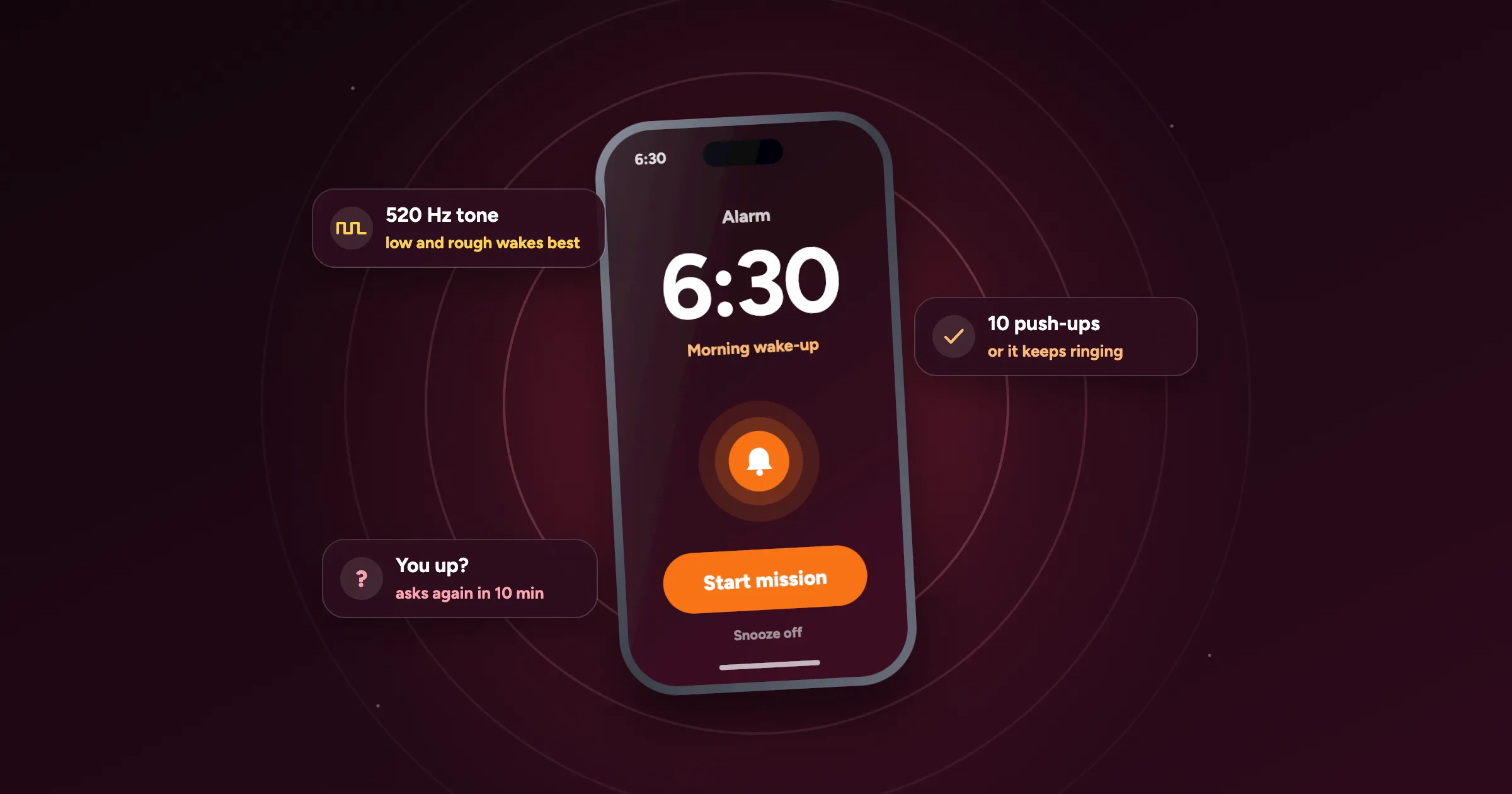
The Best Alarm for Heavy Sleepers: What Actually Wakes You Up
Sleep through every alarm? What research says about sound, vibration, light and mission alarms, how to set up your phone, and which alarm type fits you.
Read the guide →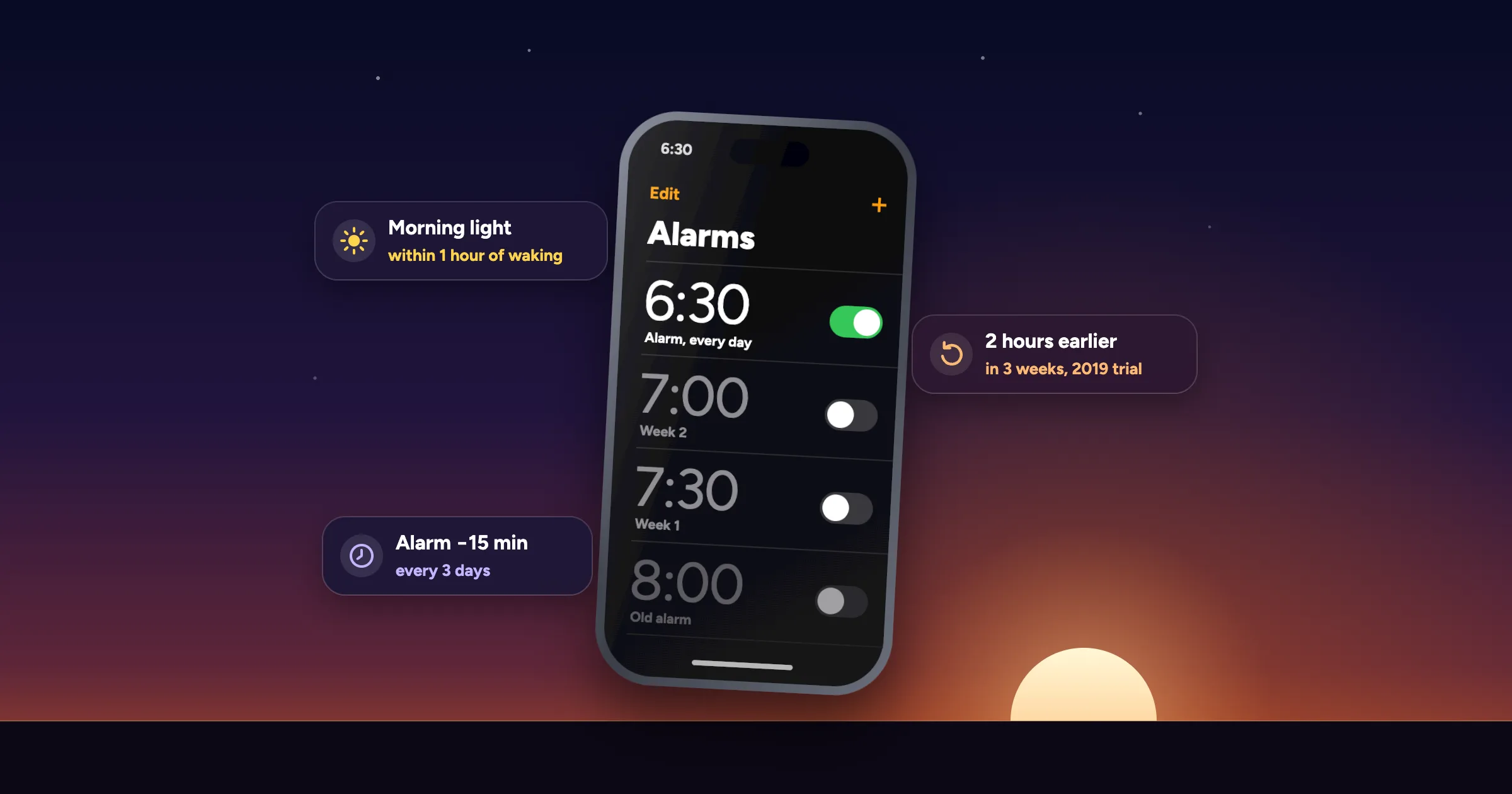
How to Wake Up Early, Even If You’re a Night Owl: A 3-Week Plan
Night owl who wants your mornings back? The 3-week plan behind a trial that moved sleep 2 hours earlier: 15-minute steps, morning light and one weekend rule.
Read the guide →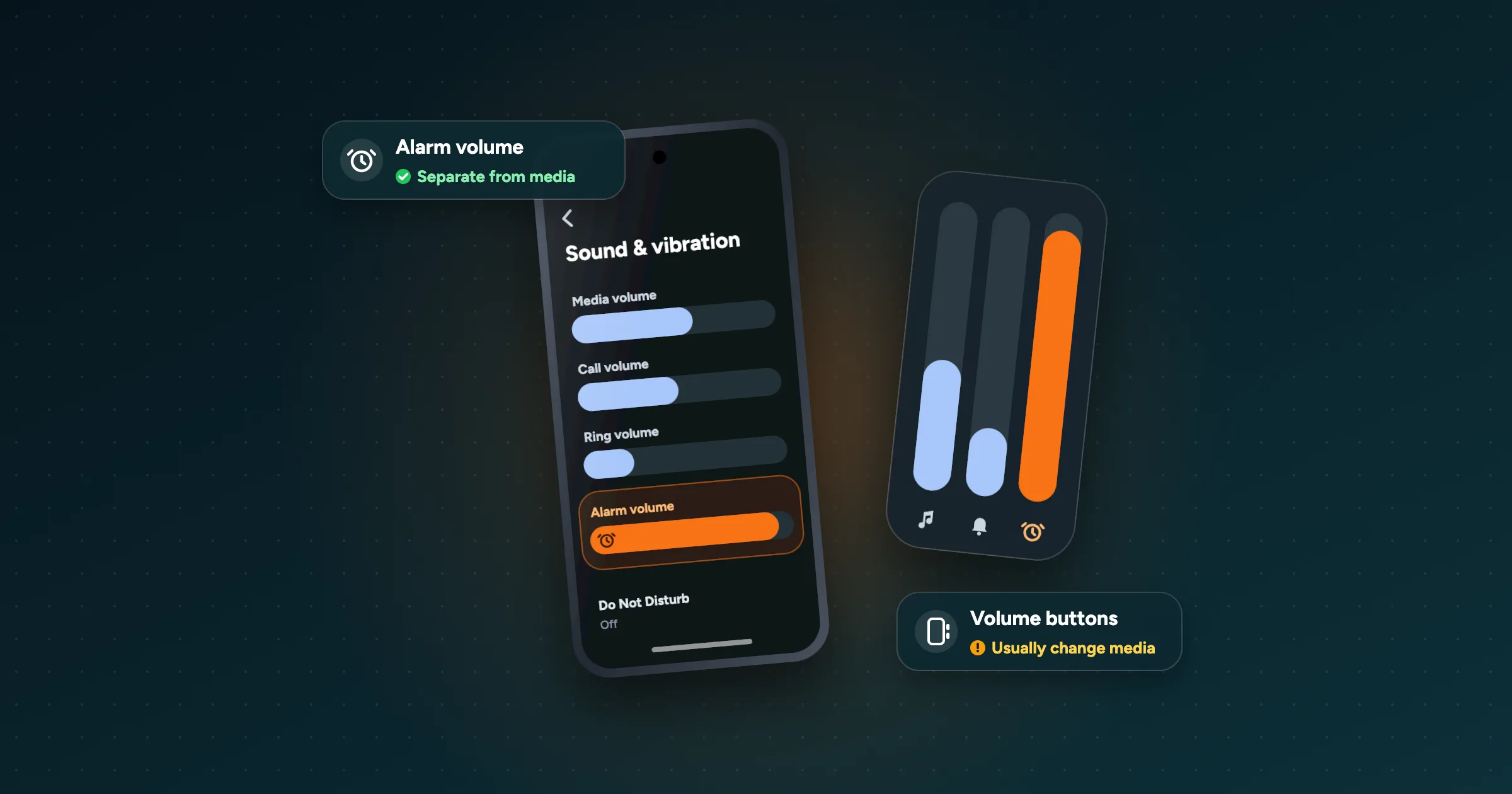
Android Alarm Too Quiet? How to Turn Up the Alarm Volume on Samsung, Xiaomi and Pixel
Android alarm too quiet or silent? Where the alarm volume is on Samsung, Xiaomi and Pixel, why it keeps going down, and how to change the alarm sound.
Read the guide →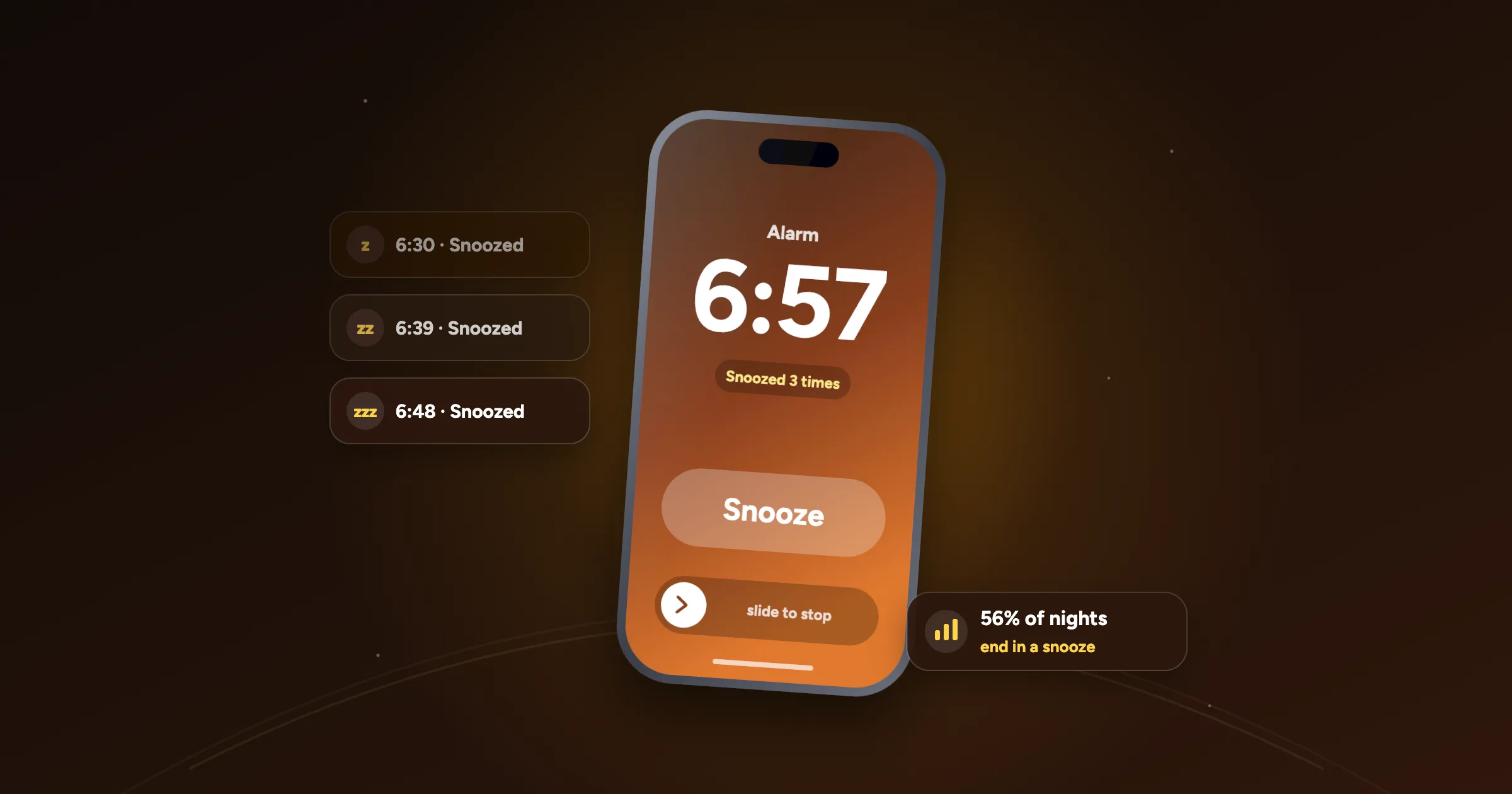
Is Hitting Snooze Bad for You? What 4 Studies Actually Found
Does hitting snooze make you more tired? What four studies actually found, why you keep doing it, when it’s fine, and how to stop, plus how to turn snooze off.
Read the guide →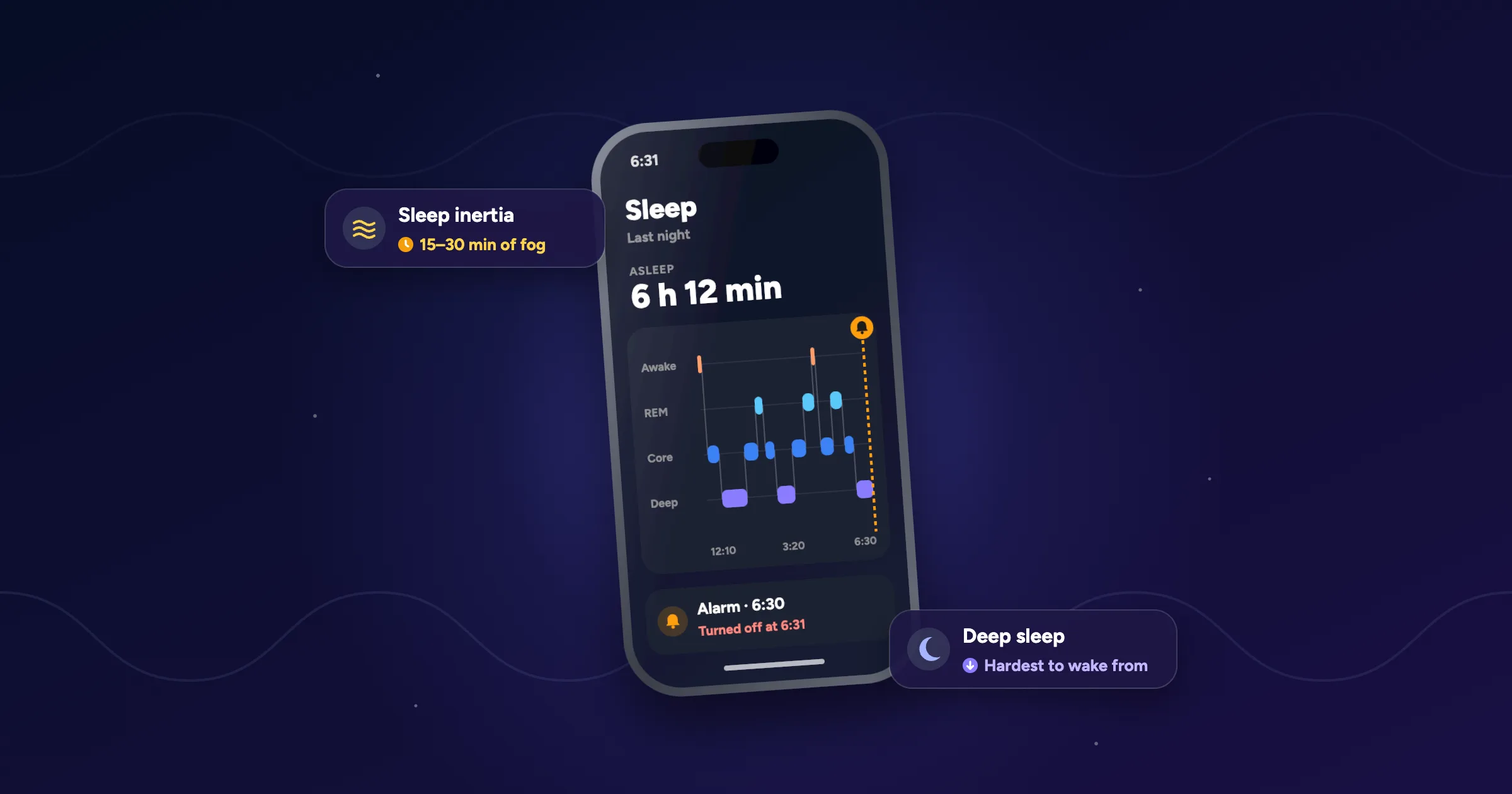
Why Can’t I Wake Up to My Alarm? 7 Reasons You Sleep Through It
Sleeping through your alarm, or turning it off without remembering? The 7 real reasons, from sleep inertia to your body clock, and the fixes that work.
Read the guide →
Will My Alarm Ring on Silent, Vibrate or Do Not Disturb? iPhone and Android
Usually yes, on iPhone and Android. But 6 things can still silence it, from a hidden Samsung setting to your Apple Watch.
Read the guide →
iPhone Alarm Too Quiet? How to Change the Alarm Volume on iOS 27 and iOS 26
Make your iPhone alarm louder: the new separate alarm volume in iOS 27, the right slider on iOS 26, the sleep alarm’s own volume and 6 more fixes.
Read the guide →
Android Alarm Not Going Off? 9 Fixes for Samsung, Pixel, Xiaomi and More
Android alarm didn’t ring, rang late or only showed a notification? 9 fixes with the exact settings for Samsung, Pixel, Xiaomi, TECNO, OPPO and vivo.
Read the guide →
iPhone Alarm Not Going Off? 10 Fixes for iOS 27 and iOS 26
iPhone alarm not going off or not working after the iOS 27 update? 10 fixes: no sound, too quiet, only on Apple Watch, the new alarm volume and alarm apps.
Read the guide →